
Hiking to Tiger’s Nest: a practical guide
How long the walk to Taktsang takes, how hard it is, what to wear and bring, and how to time it for the best of the day.
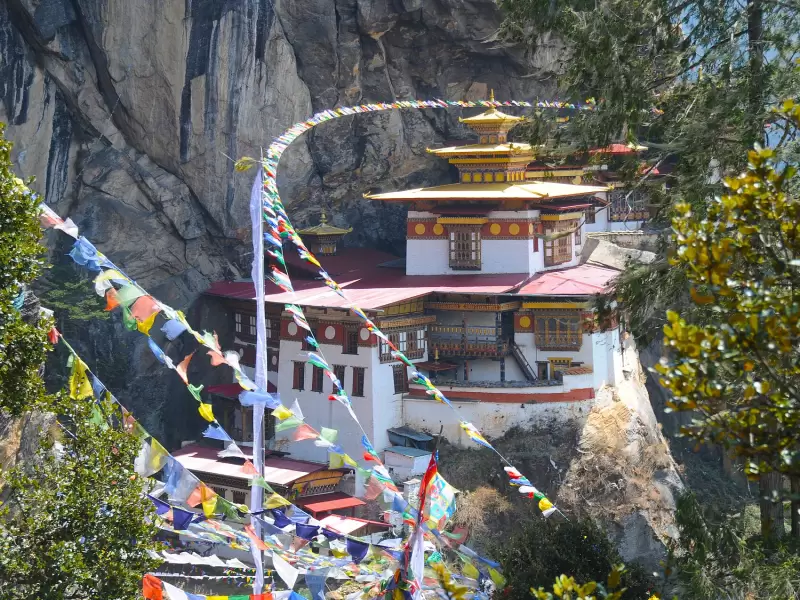
Taktsang, the Tiger’s Nest, is the place most people picture when they think of Bhutan: a cluster of white temples on a ledge of rock, about 900 m above the floor of the Paro valley. There is no road. You walk, and the walk is a large part of why it stays with people.
The walk in numbers
| Distance | About 7 km there and back |
|---|---|
| Time | 4 to 5 hours, including the visit |
| Start | Car park at about 2,600 m, a short drive north of Paro town |
| Monastery | 3,120 m |
| Height gained | A little over 500 m, plus the steps at the end |
| Path | Wide, well-trodden earth and stone, then stone steps |
The route, stage by stage
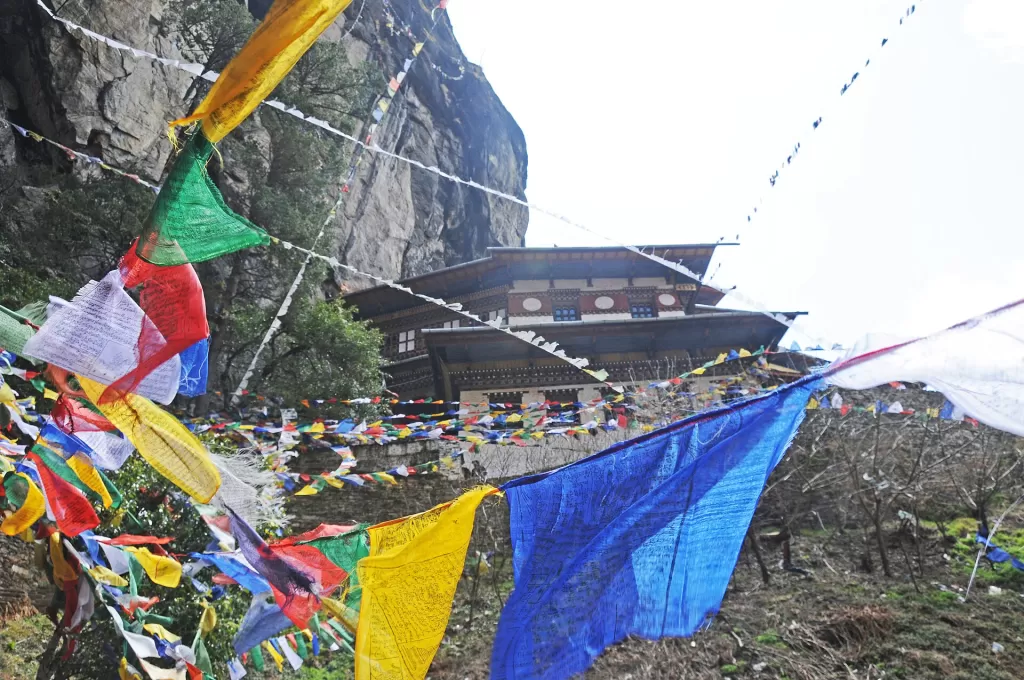
Car park to the teahouse, about an hour. The path climbs steadily through blue pine, past a water-driven prayer wheel and strings of prayer flags. This is the steepest sustained part. The teahouse sits on a shoulder of the hill with a clear view of the monastery across the gorge, and it serves tea, coffee and a simple lunch.
Teahouse to the viewpoint, 45 minutes to an hour. The gradient eases, and the trail winds upward through forest hung with lichen until you come out level with Taktsang, and slightly above it. This is where the well-known photographs are taken.
Viewpoint to the monastery, 20 to 30 minutes. A long staircase of stone steps drops into the gorge, crosses a bridge beneath a waterfall and climbs again to the gate. It is the part people find hardest on the way back.
The visit, about an hour. Your guide takes you through the temples, including the cave where Guru Rinpoche is said to have meditated.
The descent, an hour and a half to two hours. Downhill all the way after the steps, and hard on the knees. Walking poles help.
How hard is it?
It is a hill walk, not a climb. Anyone who is comfortable walking uphill for a couple of hours at home can do it. What makes it feel harder than the figures suggest is the altitude: you are breathing thinner air than you are used to, and you will be slower. Go at a pace at which you can still talk, and stop whenever you want.
If the whole walk is more than you want, going as far as the teahouse is a perfectly good outing. The view from there is excellent, and plenty of people stop at that point.
Ponies
Ponies can be hired at the car park to carry you up as far as the teahouse. They do not go beyond it and they do not carry riders down. If you are thinking of riding, tell your guide the day before.
When to go
Start early, by about eight o’clock. The climb is cooler, the path is quieter, and you are down before the afternoon. Most of our itineraries put Tiger’s Nest near the end of the trip, when you have had several days to get used to the altitude and the walk feels much easier.
The walk is possible all year. In the monsoon, from June to August, the path is muddy and the monastery drifts in and out of cloud. In winter there can be ice on the steps in the early morning.
What to wear and bring
- Walking shoes or boots with a good grip. Not sandals, and not smooth-soled trainers.
- Long trousers and a top with sleeves. Taktsang is a working monastery and the dress code is enforced at the gate.
- Layers. You will be warm on the climb and cold when you stop.
- A waterproof, a sun hat and sun cream
- At least a litre of water each
- A walking pole. Wooden sticks can be hired at the car park for a small charge.
- Some cash for tea at the teahouse and for offerings
At the monastery
Cameras, phones and bags may not be taken inside. You leave them in lockers at the gate, so bring nothing you would worry about. Shoes come off at each temple. Photography is allowed everywhere outside.
The entry fee in 2026 is Nu. 1,000 for an adult and Nu. 500 for a child of 6 to 17; children of 5 and under pay nothing. Accounts of the walk give the opening as about 8 in the morning, with the temples shut from 1 to 2 o’clock while the monks eat: your guide times the climb around it.
The story
Guru Rinpoche, who brought Buddhism to Bhutan in the 8th century, is said to have flown to this cliff on the back of a tigress and meditated in a cave here. That gave the place its name. The monastery around the cave was built in 1692. It was badly damaged by fire in 1998 and rebuilt over the following years.
A different way to see it
If you would like to arrive from above, with almost nobody else on the path, the Bumdra trek camps a night on the mountain behind and walks down to Taktsang the next morning. Every other trip we run includes the walk from the valley. The shortest is the four-day Bhutan Short Trip.