

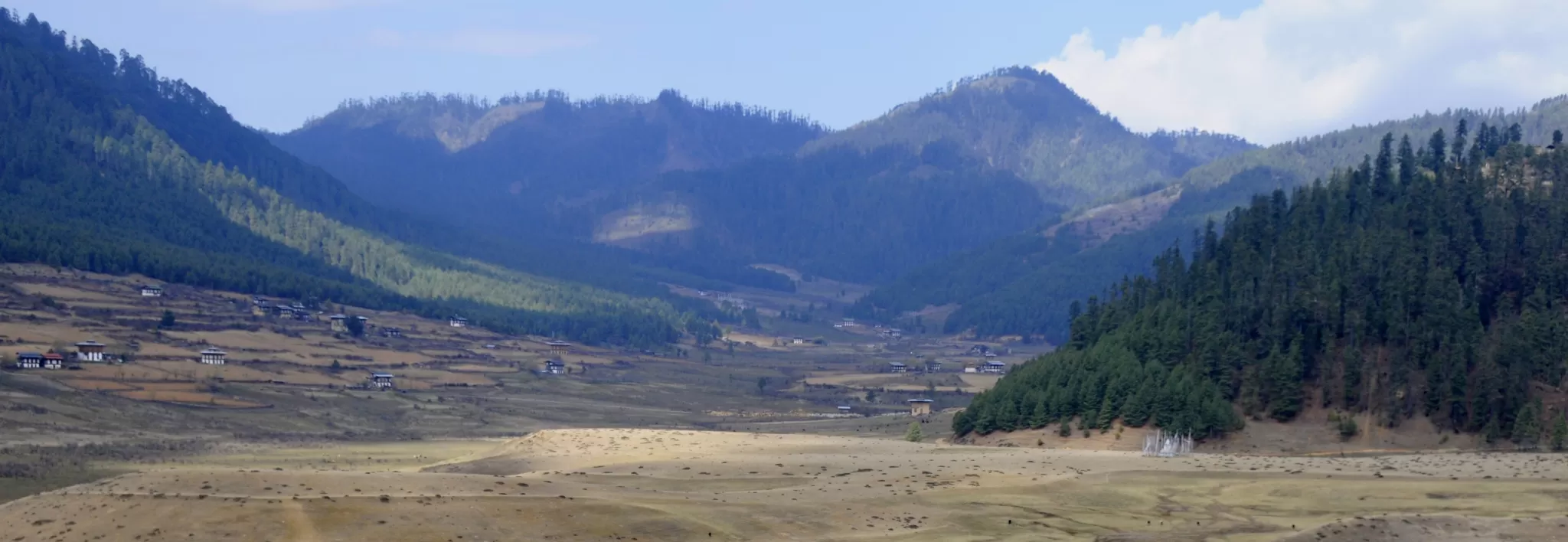
Bhutan is a kingdom in the eastern Himalaya, between India to the south and the Tibetan plateau to the north. It is about the size of Switzerland and has fewer than 800,000 people. The land rises from subtropical forest on the Indian border to peaks above 7,000 m in less than 200 km, and the country lives in the valleys in between.
Facts at a glance
| Capital | Thimphu |
|---|---|
| Area | About 38,400 square kilometres |
| Government | Constitutional monarchy |
| Head of state | His Majesty King Jigme Khesar Namgyel Wangchuck, the Fifth King |
| National language | Dzongkha. English is widely spoken and is the language of schools. |
| Religion | Mainly Buddhist, with a large Hindu community in the south |
| Currency | Ngultrum (Nu.), equal in value to the Indian rupee |
| Time | Six hours ahead of GMT, with no daylight saving |
| Dialling code | +975 |
| Highest mountain | Gangkar Puensum, 7,570 m |
| National animal | The takin |
| National sport | Archery |
The land
Bhutan has three bands of country. In the south, foothills covered in subtropical forest rise from the plains of India. In the middle lie the inner valleys, at 1,200 m to 3,000 m, where most Bhutanese live and where almost all visitors travel: Paro, Thimphu, Punakha, Phobjikha, Bumthang. In the north are the high Himalaya, yak pastures and the snow peaks along the border.
High ridges separate one valley from the next, and the only road that crosses the country climbs over a pass between each of them. That is why distances in Bhutan are measured in hours, and why each valley has kept its own character, and often its own language.
A short history
Buddhism reached Bhutan in the 7th and 8th centuries. Tradition says the Tibetan king Songtsen Gampo built the first temples, among them Kyichu in Paro and Jambay in Bumthang, and that Guru Rinpoche, the saint Bhutanese revere above all others, meditated at the cliff where Tiger’s Nest now stands.
The country was unified in the 17th century by Zhabdrung Ngawang Namgyal, a lama who came south from Tibet. He built the great dzongs, fortresses that housed both monks and administrators, and set up a system of government that lasted more than two hundred years. Punakha Dzong, built in 1637, was his capital.
In 1907 the country’s leaders chose Ugyen Wangchuck, the governor of Trongsa, as the first hereditary king. His descendants have reigned ever since. Bhutan was never colonised. It stayed closed to the outside world until the 1960s, opened to visitors in 1974, and introduced television and the internet only in 1999. In 2008 it adopted a written constitution and held its first parliamentary elections, at the wish of the Fourth King.
Gross National Happiness
In the 1970s the Fourth King said that Gross National Happiness mattered more than Gross National Product, and the phrase became the country’s guiding idea. In practice it means that policies are judged by what they do for people’s wellbeing, for culture and for the natural world, as well as for the economy. We have written about it in more depth in Gross National Happiness.
Forests and wildlife
The constitution requires that at least 60 per cent of Bhutan stays under forest for all time, and the actual figure is higher. National parks and the corridors that link them cover a large share of the country. Tigers, snow leopards, red pandas, takin and black-necked cranes all live here. Bhutan’s forests absorb more carbon dioxide than the country emits.
People and daily life
Bhutanese wear national dress to work, to school and on formal occasions: the gho, a knee-length robe, for men, and the kira, an ankle-length dress, for women. Houses are built to traditional designs, with painted woodwork and no nails in the frame. Archery matches draw crowds at weekends. Chillies and cheese are on the table at almost every meal.
Thimphu, the capital, is a town of well over 100,000 people with no traffic lights. A policeman directs the cars at its busiest junction.
Visiting
Bhutan has kept its doors only partly open on purpose. Visitors pay a daily Sustainable Development Fee, and the policy is to welcome fewer visitors, each contributing more, so that tourism pays for the country without wearing it out. Everything you need to know to plan a trip is in Plan your trip, and the trips themselves start with our cultural tours.