
Gross National Happiness: the idea that guides Bhutan
Where Gross National Happiness came from, what it means in practice, and what a visitor actually sees of it.
Most people who know one thing about Bhutan know that it measures happiness. That is roughly true, and more interesting than the slogan suggests. Gross National Happiness is not a claim that everyone here is happy. It is a way of deciding what a government is for.
Where it came from
The phrase belongs to Bhutan’s Fourth King, Jigme Singye Wangchuck, who came to the throne as a teenager in 1972. In the years that followed he said that Gross National Happiness was more important than Gross National Product. Bhutan was then just beginning to build roads, schools and hospitals, and he was arguing that development should be judged by what it does for people’s lives, not only by how much it adds to the economy.
The idea was written into the constitution adopted in 2008, which directs the state to promote the conditions that allow the pursuit of Gross National Happiness.
The four pillars
In Bhutan the idea is usually explained as four pillars:
- Sustainable and fair economic development
- The preservation and promotion of culture
- The conservation of the natural environment
- Good governance
Economic growth is one of the four. Bhutan is not against prosperity. The point is that growth is not allowed to outrank the other three.
How it is measured
Bhutan carries out a national survey every few years that asks thousands of people about their lives. The questions cover nine areas: psychological wellbeing, health, education, how people use their time, culture, governance, the strength of their community, the environment around them and their standard of living. The results are combined into a Gross National Happiness Index, which shows where life is getting better and for whom it is not.
The questions are practical. How many hours did you sleep? Do you trust your neighbours? How long does it take you to reach a clinic? The survey is closer to a detailed health check on the country than to asking people whether they feel cheerful.
What a visitor sees of it
You will not see a happiness ministry. You will see the results of decisions made with those four pillars in mind.
- Forests. The constitution requires at least 60 per cent of the country to stay under forest for ever. From any pass you look out over unbroken trees.
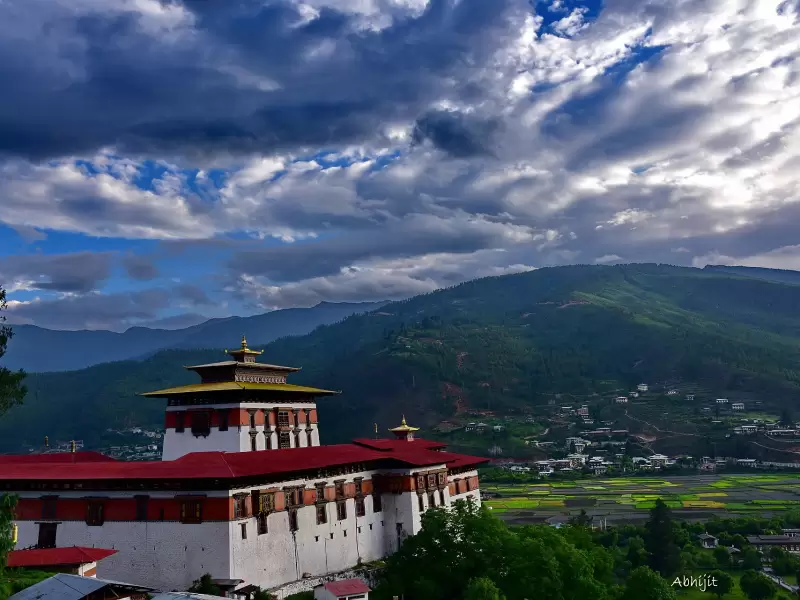
- Buildings. New buildings must follow traditional designs, which is why even a petrol station has painted window frames.
- Dress. National dress is worn in offices, schools and dzongs.
- Health and schooling. Both are free for Bhutanese citizens.
- Tourism. The Sustainable Development Fee, and the policy of fewer visitors, come from the same thinking. The fee you pay helps fund the things above.
The honest version
Bhutan is a developing country, and Gross National Happiness has not made its problems go away. Jobs for young graduates are scarce, and in recent years many young Bhutanese have left to work and study abroad, above all in Australia. Villages are losing people to the towns. Bhutanese discuss all of this openly, and often in the language of Gross National Happiness itself: is the country living up to its own idea?
That may be the most useful way to understand it. It is not a description of how things are. It is the question Bhutan has chosen to ask itself.
Beyond Bhutan
The idea has travelled. In 2011 the United Nations General Assembly adopted a resolution, proposed by Bhutan, calling happiness a fundamental human goal, and 20 March is now marked each year as the International Day of Happiness.
If you would like to see what the idea looks like on the ground, a week is enough to start. Our seven-day tour of western Bhutan takes in the capital, two rural valleys and a good many conversations with your guide along the way. There is more background in About Bhutan.