
The Druk Path trek, day by day: what to expect
Six days from Paro to Thimphu on foot: what each day involves, how life in camp works, how fit you need to be and when to go.
The Druk Path crosses the ridge between Paro and Thimphu. It is about 55 km long, takes six days, and is the trek we suggest to people who have not trekked in the Himalaya before. This is an honest account of what each day is like, so that you can decide whether it is for you.
The trek at a glance
| Distance | About 55 km |
|---|---|
| Days on foot | Six, with five nights in camp |
| Walking each day | 3 to 5 hours |
| Highest camp | Simkotra Tsho, 4,110 m |
| Highest point | A pass at about 4,200 m |
| Grade | Moderate |
| Permits | None needed |
| Best months | March to May, late September to November |
Before you start: two nights in Paro
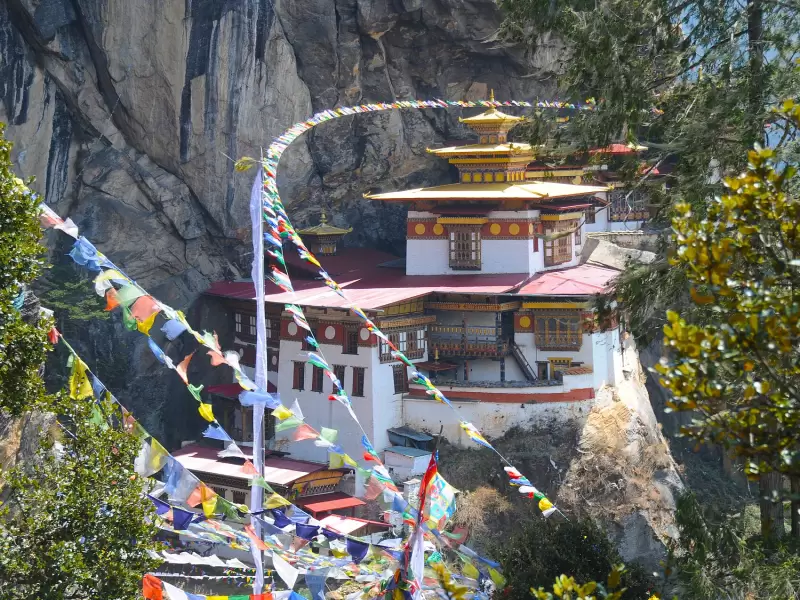
Nobody should fly in to 2,200 m and start climbing the next morning. Our trip gives you two nights in Paro first, with the walk to Tiger’s Nest on the second day. That takes you to 3,120 m and back down to sleep, which is the best preparation there is.
Day 1: Paro to Jele Dzong
The hardest day comes first. From the hillside above the National Museum the trail climbs more than 1,000 m in four to five hours, through farmland and then forest. It is never steep enough to need your hands, but it does not let up. Camp is in a clearing below Jele Dzong, a small fortress on the ridge, at about 3,500 m. You will probably sleep lightly tonight. That is normal on a first night at altitude.
Day 2: Jele Dzong to Jangchulakha
A gentler day of three to four hours along the ridge, in and out of rhododendron forest. In April and May the trees are in flower. The camp at Jangchulakha, 3,770 m, is on open yak pasture.
Day 3: Jangchulakha to Jimilang Tsho
About four hours along the crest. If the weather is clear this is the day for mountain views, with Jomolhari and Jichu Drake to the north. The trail drops at the end to Jimilang Tsho, a long lake at 3,870 m, and the tents go up on its shore.
Day 4: Jimilang Tsho to Simkotra Tsho
Four to five hours, climbing past a second lake, Janye Tsho, to a third. Simkotra Tsho is the highest camp, at 4,110 m, and the coldest. Expect frost on the tent in the morning in any season.
Day 5: Simkotra Tsho to Phajoding
A gradual climb to the highest pass, at about 4,200 m, and then the first sight of Thimphu, a long way below. On a clear day Gangkar Puensum, Bhutan’s highest mountain, can be seen on the horizon. The descent to the monastery at Phajoding takes the afternoon.
Day 6: Phajoding to Thimphu
Three hours downhill through pine forest to the edge of the city. By lunchtime you are in a hotel with a hot shower, which after five nights in a tent is a memorable thing.
A day in camp
Days on trek follow a pattern. The morning usually starts with a hot drink at your tent and a bowl of warm water for washing. After breakfast in the dining tent you set off with your guide, carrying only a day pack. The crew strike camp, load the ponies, overtake you on the trail and have the tents up again by the time you arrive, usually early in the afternoon.
The afternoon is yours: a rest, a short walk to a viewpoint, a book. Dinner is a proper cooked meal, and most people are asleep soon after dark.
The crew is typically a guide, a cook, one or two helpers and a horseman with the pack ponies. You have a sleeping tent, a dining tent and a toilet tent. There are no showers and no phone signal for most of the route.
How fit do you need to be?
Fit enough to walk uphill for four or five hours and get up and do it again the next day. You do not need to have trekked before. Regular hill walking in the two months before you come is the best training, ideally on consecutive days.
The real test on this route is altitude, not distance. Most of the nights are spent above 3,700 m. Most people feel it as breathlessness on the climbs and a poorer night’s sleep, and nothing more. Your guide watches for the signs of anything worse and will bring you down if needed. There is more in our article on altitude in Bhutan.
When to go
April and May for rhododendrons and milder nights. October and November for the clearest skies and the best views, with colder nights. March and late September can be very good and are less predictable. The trek is not walked in the monsoon or in the depth of winter, when snow lies on the ridge.
What to bring
Good boots that you have already worn in, a warm sleeping bag, a down jacket, waterproofs and layers. The full list is on our packing page.
Is there something shorter, or harder?
If you have less time, the Bumdra trek gives you one night in camp above Paro, and the Tsaluna trek walks the first three days of the Druk Path and then drops to a road, which saves two days. If you want something quieter, look at the Dagala Thousand Lakes trek. If the Druk Path sounds too easy, the Jomolhari trek is the next step up.
The full itinerary, with what is included, is on the Druk Path trek page.