
Bhutanese food culture: how Bhutan eats
Three meals of rice a day, a stove at the centre of the house, and a polite refusal before every second helping: the customs behind Bhutanese food.
A list of dishes tells you what is on the plate. It does not tell you why a Bhutanese host fills your bowl again while you are still saying no, or why the family eats after you have finished. This is a short account of Bhutanese food culture: how the country eats, and what a guest should know. For the dishes themselves, see our guide to Bhutanese food.
Rice, three times a day
The Dzongkha word for a meal is the word for rice. Breakfast is often last night’s rice fried with a little chilli, or fresh rice with a relish and a cup of butter tea. Lunch is rice with one or two dishes. Dinner is rice again. A farmer working the fields will eat a quantity of it that visitors find hard to believe.
Where rice will not grow, the staple changes. In Bumthang, above 2,600 m, it was buckwheat, eaten as noodles and pancakes. In parts of the east it was maize. Roads and shops have brought rice everywhere, but the old staples are still cooked, and still preferred by the people who grew up on them.
The kitchen and the stove
In a traditional farmhouse the kitchen is where the household lives, around a stove that burns wood and warms the room as well as the pots. Meals are eaten there, sitting on the floor, with the dishes set in the middle. The person who cooked serves everyone, and commonly eats last.
Food was traditionally eaten with the right hand. A little rice is pressed into a ball and used to pick up the vegetables and sauce. Spoons are now usual in towns, and you will always be given one.
Bowls and baskets
Two objects are worth looking for. The first is the wooden bowl turned from a single piece of wood, a craft of Trashiyangtse in the far east. Many older people carry their own cup. The second is the bangchung, a pair of woven bamboo bowls that fit together as a lid and a base, made in the south-central hills. It is a plate and a lunch box in one, and you will see families unpacking them on the grass at any festival.
Being a guest
- You will be served first, and more than you can eat. Generosity is the point.
- Refuse before you accept. When more is offered, the polite answer is “meshu, meshu”, with a hand over your mouth. Your host will insist, and you accept. It is courtesy on both sides, not pressure.
- If you truly want no more, leave a little in the bowl. An empty bowl is an invitation to refill it.
- Tea comes first. A visit begins with butter tea or sweet milk tea, usually with puffed rice or flattened maize to eat with it.
- A few drops for the unseen. You may see someone flick a little tea or spirit into the air with a finger before drinking. It is an offering, and you are not expected to copy it.
- Wait to be shown where to sit, and do not step over dishes laid on the floor.
More on manners in general is on our page about etiquette and dress.
Buddhism and meat
Bhutan is a Buddhist country, and taking life is avoided: few Bhutanese will slaughter an animal, and fishing is restricted. Yet most people eat meat when it is there, and much of it is brought in from India. In the first and fourth months of the Bhutanese calendar, and on certain holy days, meat is not sold at all. Dried meat, kept from before, carries households through.
This is why so much Bhutanese meat is dried, and why the vegetable and cheese dishes are not side dishes. They are the main part of the meal.
Doma
After a meal, and at most other times, many Bhutanese chew doma: a piece of areca nut wrapped in a betel leaf with a dab of lime. It reddens the mouth and warms the body. Offering doma is an old gesture of friendship. You may be offered it, and it is entirely acceptable to decline; it is strong, and an acquired taste.
Food at festivals and through the year
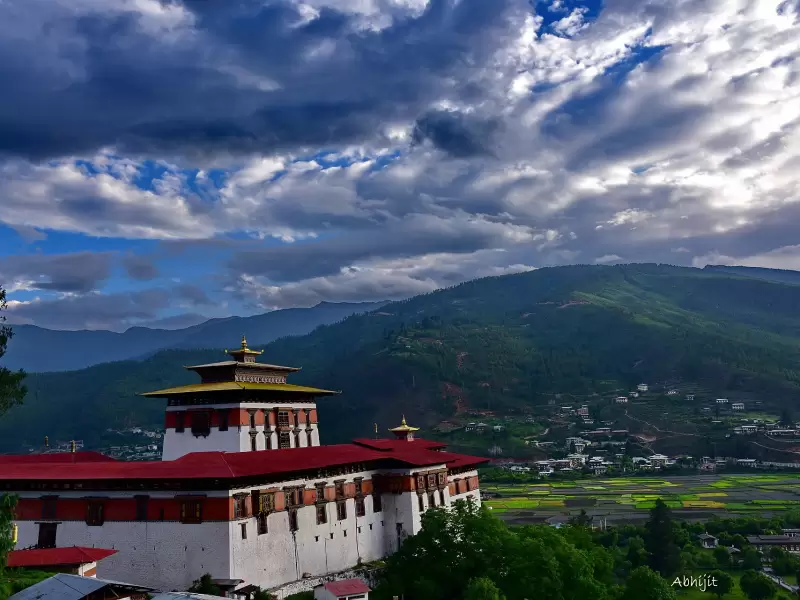
A tshechu is a picnic as much as a religious occasion. Families arrive in their best clothes with a day’s food packed in baskets, and at midday the ground outside the dzong is covered with people eating together.
- Spring: fern shoots, wild asparagus and the first green chillies.
- Summer: wild mushrooms, among them the prized matsutake, which has a festival of its own in the Ura valley of Bumthang in August.
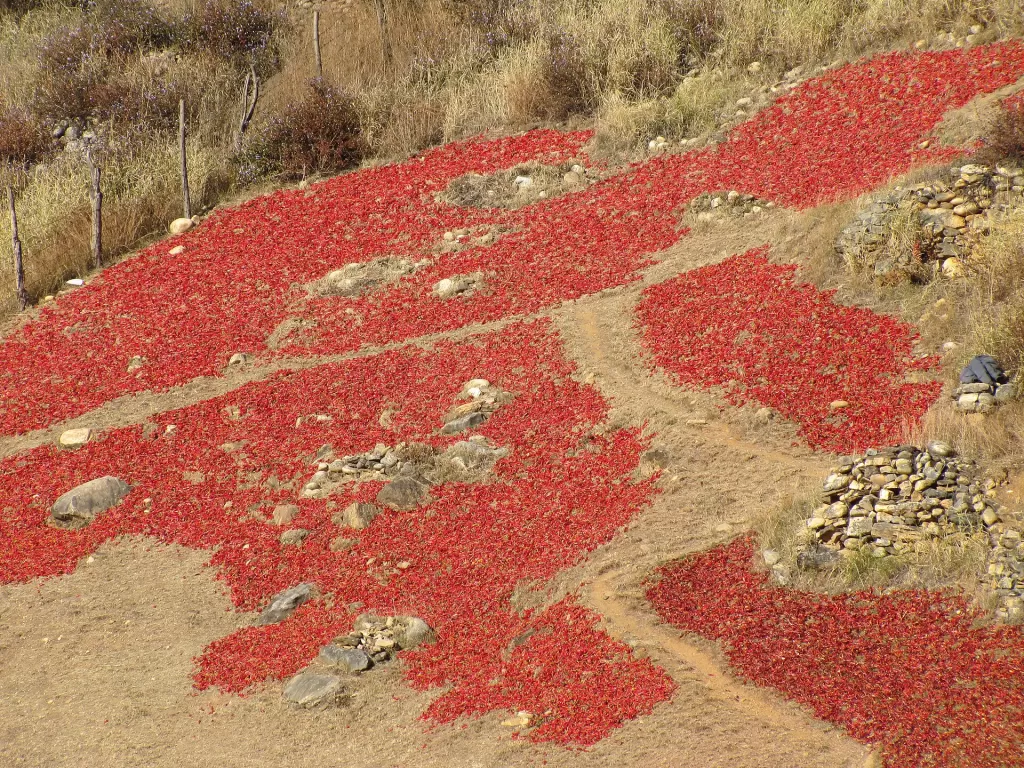
- Autumn: the rice harvest, and chillies drying on every roof.
- Winter: dried vegetables, dried meat and dried cheese. In Haa and Paro the new year festival of Lomba is the season for hoentay, buckwheat dumplings filled with turnip greens and cheese.
Seeing it for yourself
The best introduction is a meal in someone’s house. Several of our trips include a farmhouse visit, and one can be added to any of them: tell us when you plan your trip. The weekend market in Thimphu is the other place to go, for the dried cheese, the chillies by the sack and the red rice sold by the scoop.