

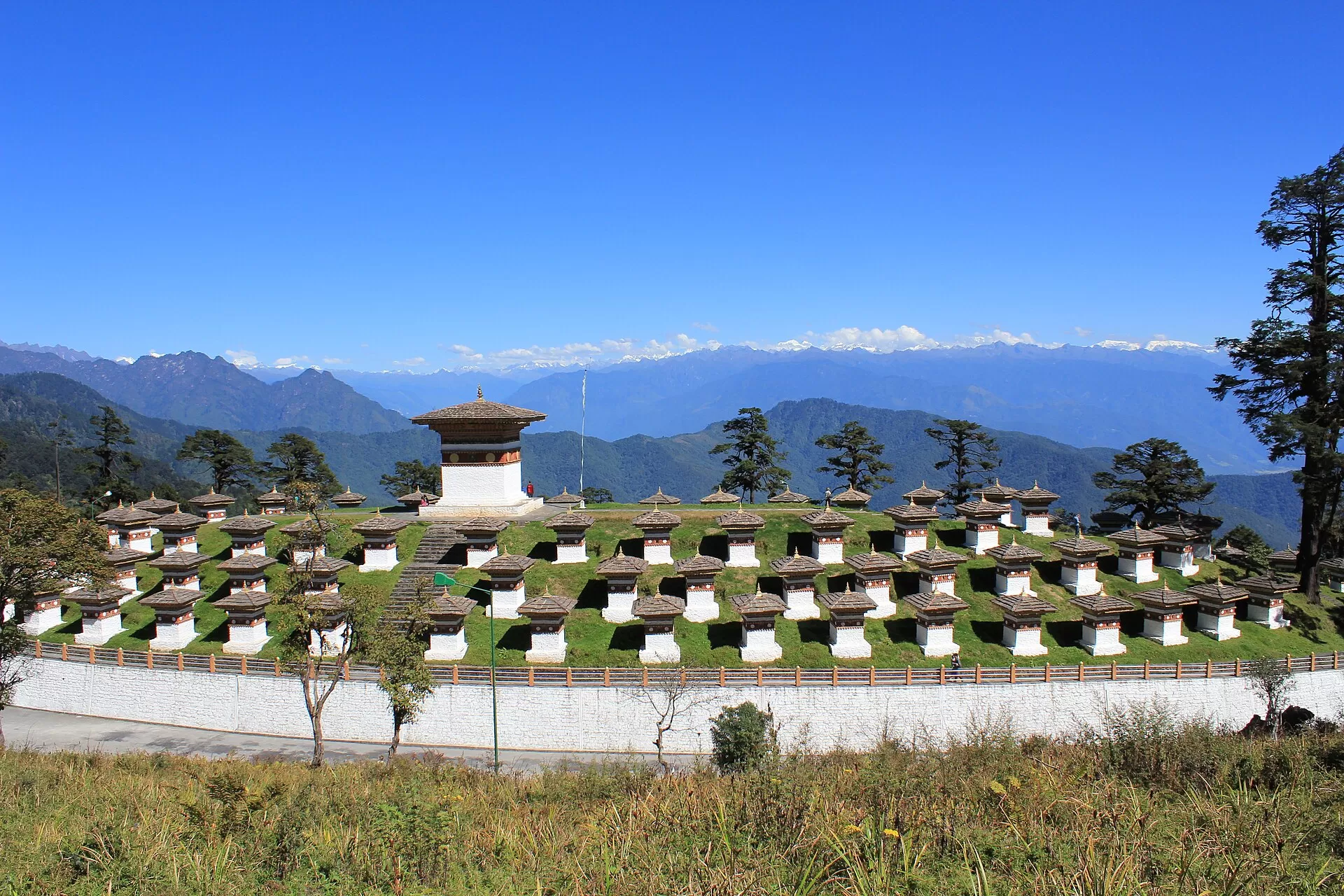
January is the heart of the Bhutanese winter: cold, dry and very clear, and one of the quietest months of the year. The sky is a hard blue, the high passes carry snow, and you will often have a dzong to yourself.
- Good for: clear mountain views from the road passes; Black-necked cranes in Phobjikha; Quiet dzongs and lower hotel prices.
- Less good for: trekking: every route is closed; The cold, morning and evening.
The weather in January
In January Thimphu averages 15°C by day and −2°C at night, with 6 mm of rain. Punakha, a thousand metres lower, averages 19°C and 6°C. It hardly rains at all. Nights in Paro, Thimphu and Bumthang fall below freezing, so pack as you would for winter at home. Snow falls on the high passes, and a road pass can close for a day or two after it.
| Valley | Day | Night | Rain |
|---|---|---|---|
| Paro | 13°C | −1°C | 7 mm |
| Thimphu | 15°C | −2°C | 6 mm |
| Punakha | 19°C | 6°C | 14 mm |
| Bumthang | 11°C | −4°C | 6 mm |
Averages for the month: the highest and lowest temperature of an ordinary day, and the month’s rainfall. It is colder on the passes and at any camp on a trek. Figures from the National Center for Hydrology and Meteorology, whose stations are at Paro (2,406 m), Thimphu (2,310 m), Punakha (1,236 m) and Jakar in Bumthang (2,470 m).
Festivals in January
The festivals that begin in January, as the official list has them:
- Lhuentse Tshechu: 5–9 January 2028, Lhuentse Dzong
- Trongsa Tshechu: 5–9 January 2028, Trongsa Dzong
- Samdrup Jongkhar Tshechu: 10–12 January 2028, Samdrup Jongkhar
- Nabji Lhakhang Drup: 12–14 January 2028, Nabji Lhakhang, Trongsa
Festival dates follow the lunar calendar and move each year, and the list is the Department of Tourism’s tentative one. The whole year is in our festival calendar.
Trekking in January
The treks are closed in January: the passes are under snow and the camps are bitterly cold. Walking is by the day, and the day walks are at their clearest: the climb to Tiger’s Nest, the path up to Khamsum Yulley Namgyal Chorten above Punakha, and the trails across the Phobjikha valley.
To see when each route is walked, look at Bhutan’s treks compared.
Where to go in January
Go low, and stay in the west. Punakha, at about 1,240 m, is mild in the middle of the day. The black-necked cranes are in the Phobjikha valley, where they spend the winter. And the view of the eastern Himalaya from Dochu La is often at its best of the whole year.
Good to know
Hotels and flights cost less than in spring and autumn, though the Sustainable Development Fee is the same in every month. Bring warm layers, a hat and gloves. What to bring is on our packing list.
Trips for January
- Bhutan Short Trip (4 days)
- Western Valleys Discovery (5 days)
- Complete Western Bhutan (7 days)
Tell us your dates and we will say plainly what January is like for the trip you have in mind.
Other months
Bhutan in December comes before, and Bhutan in February after. For the year as a whole, see the best time to visit Bhutan.
Weather averages are for 1996 to 2017 (Punakha from 1990). Festival dates were checked against the official tentative list on 12 October 2026.